A few years ago, a musician friend told me he wanted to initiate a startup and create an educational series for children to learn music. I was against the idea back then and still now.
The musical instrument is what liberates the human from the limitations of flesh. We can sing; we can clap. Mouth the words; tap the beats. But what carries the desire in our voice beyond the vibration of our vocals is the yawning of the bell of the trumpet. What thumps louder than the heart is the drum. An expansion of sound that hits the walls with waves of lyricism and rhythm. Piano keys trill under the flying fingers of one — as if a dozen were singing. A blend of voices in a choir. The musical instrument carries what we want to say in melody. We step on the pedal; we blow into a mouthpiece; we pound, press, or strike the keys. Listen to what I want to say beyond words.
And it feels good to say what I want to say. It feels great. It feels friggin awesome. And if there’s a better way of saying what I want, out goes the old way. Harpsichord. Sure. But can you imagine Elton John playing the harpsichord? Right? Right. So, “Move over Pure Overtone,” says Piston & Valves. Another sound is in town.
Yet the evolution of musical instruments has been traditionally slow. Take the wind instrument as an example. For the longest time (and counting), the most innovative development has been…the saxophone. Because of material limitations, innovation in instrument design mirrors the limitations in industrial design. Breakthroughs hinge upon what new material is or isn’t there and what can or cannot be done with it. There aren’t that many options; nor are they terribly exciting. Digital possibilities, on the other hand, offer the imagination much more.
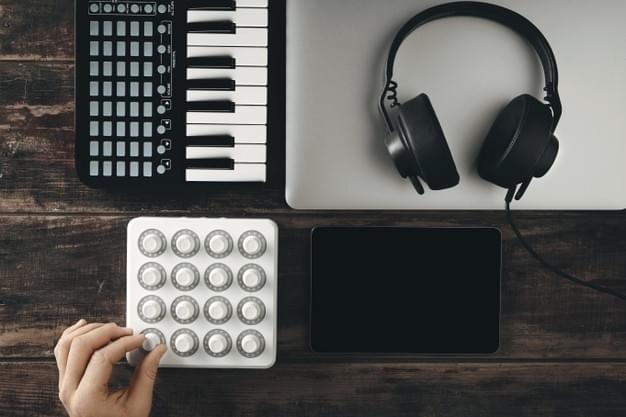
What we can do with our hands, we do much more with a computer at our finger tips. Similarly, the musical instrument gets a boost from digital expansion when plugged into technology. The DJ is the modern composer, moving around blocks of code to create the latest remix. This is much like grabbing a pre-existing template, but to create something new with it. And it’s how most of us work now, or increasingly will. Can a tune be brand new? Hardly completely. What we need to figure out is how to rework, reconfigure, reuse what generations of talent have left behind. Allowing people to effectively and efficiently mine the building blocks of the past, so that more of us can create and be creators ourselves should be the tune that we sing to.
Naturally, this might lead to the demise of the music shop. Fewer and fewer people will want to learn an actual instrument. Because no longer do we need to spend years practicing until our muscles acquire the memory to play. Musicians will become more like dancers. Happiness will come from movement. Years of training will allow their hands, feet, fingers and toes, to move in tandem with the melody they create. The dance of the musician still commands attention on the stage, where “live” comes alive. But we are no longer living in the 19th century, where a live music performance was one of the few options available that made entertainment larger than life. We have so many other lives we can live now. Too many options. Lounge. House. Jazz. Rock. Alternative. Grunge. Funk. Beer. Whiskey. Wine. Listening to an orchestra in evening wear? Rather quaint and static in comparison.
In the context of augmented reality and virtual reality, where technology creates an immersive experience, what musicians-as-performers do will become more and more like the backup dancer. Because they are real, they move, their instruments sing, they are entertaining. We are drawn to them, both body and sound. If all this group of people did was play the French horn in accompaniment, seated, then why not just play the horn from an audio source? That’s why I believe the musician’s stage will increasingly be where the musician “dances” rather than plays.
Of course, this rather limits the possibilities for musicians, but if you’re making music or want to make original music, what makes a performer and performance needs to be re-examined. Let’s say the following conditions are true: 1) peoples’ desire to perform show no signs of waning; 2) musical instruments become relatively easy to learn; 3) entertainment technology continues to evolve.
If so, then what effectively defines a “musical instrument” would be its ability to act as an output device for what we create with our cellphones and immersive technology. It would channel the combined forces of human and machine. Finger-tapping seems to be, at the moment, the most effective means of input. But it’s not the only source. If one day we could control a device with our brains, that would certainly present a breakthrough. I don’t believe there is any cause for concern if one day we see someone playing the flute without their fingers on the flute. And for the next generation of audiences, an orchestra might very well be the creation of 30 DJs behind a computer.
LED keys on a piano. Plastic brass. Bluetooth drumsticks. A bit unseemly, sure. But those were all Web 1.5. Products in transition. What I’m talking about is 2.0 and beyond. If you want a piece of the innovation pie, this is where the beef is. Mixed metaphor and all. Dance to shout; blink to whistle. Someone’s movement is another person’s music captured in motion. In the short term, the cellphone will likely still remain the main vehicle of expression. If you’re looking to create music, this is where you’ll find yourself until 2030.
But the guitar. Hmm. I haven’t quite made up my mind about this instrument yet. At a glance, it’s a stupid device for output. But maybe there’s too much culture wrapped up in its image for us to dispose of it just yet. Too much performative masculinity; too much wood; and strings of the heart attached to its sound. Honestly, though, I do think something that takes two years to play reasonably well will account for an increasingly smaller size of the market.
According to all of the above, conventional music-making seems to be out the door. So, of course, I disagreed with my friend who wanted to make a business out of teaching kids to read music on a sheet and play notes on a scale. If we want content, we should create it with the kind of technology that intersects with the human capacity for emotive expression. The musician, once logged in, will take center stage once more.
And my thoughts don’t just stop at music. Pay-for-knowledge, industrial design, all walks of life should welcome and embrace the future as such.
The music educational startup didn’t work out, but much more interesting future of music instruments is right ahead.